TDS Implications for Foreign Remittances: Understanding TDS Rates

Table of Contents
Show More
Businesses often send money to other countries for a variety of reasons, such as to pay for services, fees, or investments in a globalized economy. To follow Indian tax rules, it is important to know what Tax Deducted at Source (TDS) means for these transfers.
Based in Delhi NCR, Tripathi & Arora Associates gives you a lot of information about TDS rates and how they affect money sent from abroad. This guide tells you everything you need to know about TDS on foreign transfers, such as rates, how to comply, and the best ways to do things.
What is TDS?
Definition of TDS
Tax Deducted at Source (TDS) is a mechanism introduced by the Indian government to collect tax at the source of income. Under this system, a certain percentage of the payment is deducted by the payer before making the payment to the recipient. The deducted amount is then deposited with the government.
Purpose of TDS
The primary purpose of TDS is to ensure tax compliance and prevent tax evasion. By deducting tax at the source, the government can collect revenue more efficiently.Reach Out to Us
TDS on Foreign Remittances
Overview of Foreign Remittances
Foreign remittances refer to the transfer of money from residents of India to non-residents or foreign entities. These transactions are common in various contexts, including:
Payments for services rendered
Royalties
Technical fees
Interest payments
Dividend payments
TDS Applicability
TDS applies to foreign remittances when the payments are made to non-residents for services rendered or income received in India. The applicability of TDS depends on the nature of the payment and the provisions of the Income Tax Act.
TDS Rates for Foreign Remittances
TDS rates on foreign remittances vary based on the type of payment and the provisions laid out in the Income Tax Act. Below are some of the common payments and their applicable TDS rates:
1. Payments for Technical Services
Rate: 40% (plus applicable cess)
Section: 194J
Details: This applies to payments made for technical services provided by foreign entities.
2. Payments for Professional Services
Rate: 40% (plus applicable cess)
Section: 194J
Details: Similar to technical services, this rate applies to professional services rendered by non-residents.
Need Assistance?
3. Payments for Royalties
Rate: 40% (plus applicable cess)
Section: 194J
Details: Royalties paid to foreign entities are subject to TDS at this rate.
4. Interest Payments
Rate: 40% (plus applicable cess)
Section: 194A
Details: Interest payments made to non-residents are also subject to TDS at this rate.
5. Payments for Sale of Goods
Rate: 40% (plus applicable cess)
Section: 195
Details: Payments for the sale of goods to foreign entities fall under this section.
6. Dividend Payments
Rate: 40% (plus applicable cess)
Section: 194
Details: Dividends paid to foreign shareholders are subject to TDS.
7. Other Payments
Rate: 40% (plus applicable cess)
Details: Payments for any other services not explicitly mentioned may also be subject to TDS at the rate of 40%.
Let's Start Your Journey
Compliance Requirements for TDS on Foreign Remittances
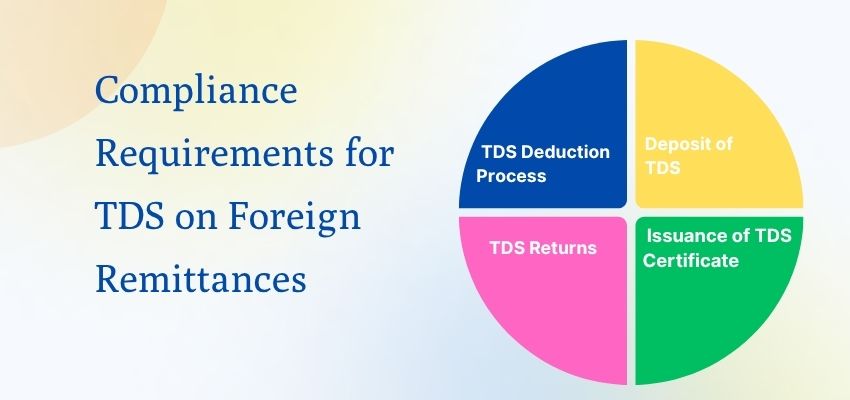
1. TDS Deduction Process
Determine Applicability: Assess whether TDS applies to the payment being made to the foreign entity.
Calculate TDS: Compute the TDS amount based on the applicable rate.
Deduct TDS: Deduct the calculated TDS amount from the payment before remitting the funds.
2. Deposit of TDS
Timeline: The deducted TDS must be deposited with the government within the stipulated time frame, typically within 7 days from the end of the month in which the deduction is made.
Challan: Use the appropriate challan (ITNS 281) for depositing TDS.
3. TDS Returns
Filing Frequency: TDS returns must be filed quarterly using Form 27Q for payments to non-residents.
Details Required: The return should include details of the deductee, payment amount, TDS deducted, and TDS deposited.
4. Issuance of TDS Certificate
- Form 16A: After filing the TDS return, a TDS certificate (Form 16A) should be issued to the foreign entity, detailing the TDS deducted and deposited.
Have Questions? Contact Us!
Common Mistakes to Avoid in Foreign Remittance TDS
When dealing with TDS (Tax Deducted at Source) on foreign remittances, it's crucial to avoid common pitfalls to ensure compliance and avoid penalties. Here are some key mistakes to watch out for:
1. Improper Classification of Payments
Ensure accurate classification of payments (e.g., royalties, fees for technical services) to apply the correct TDS rates.
2. Not Obtaining Tax Residency Certificate
Failing to obtain a Tax Residency Certificate (TRC) from the recipient can lead to higher withholding tax rates.
3. Ignoring Double Taxation Avoidance Agreements (DTAA)
Not considering applicable DTAAs can result in over-taxation. Always check for treaty benefits.
4. Incorrect TDS Rate Application
Using incorrect TDS rates can lead to under-deduction or over-deduction, resulting in penalties.
5. Failure to Deposit TDS on Time
Late deposit of TDS can attract interest and penalties. Ensure timely compliance with deposit deadlines.
6. Not Filing TDS Returns Accurately
Inaccurate TDS return filings can lead to discrepancies and penalties. Double-check all details before submission.
7. Neglecting Documentation
Failing to maintain proper documentation (invoices, agreements) can complicate audits and compliance checks.
8. Ignoring Currency Fluctuations
Not accounting for currency conversion rates can affect TDS calculations and payment amounts.
9. Assuming TDS is Not Applicable
Believing that TDS does not apply to certain foreign remittances can lead to legal issues. Always verify applicability. By avoiding these common mistakes, you can ensure smooth compliance with TDS regulations on foreign remittances.
Double Taxation Avoidance Agreement (DTAA)
Overview of DTAA
India has entered into Double Taxation Avoidance Agreements (DTAAs) with various countries to avoid taxing the same income twice. Under these agreements, residents of the contracting countries can claim relief from double taxation.
TDS Implications under DTAA
Reduced Rates: DTAAs often provide for reduced TDS rates on specific payments, such as royalties and technical fees.
Tax Residency: To avail of DTAA benefits, the recipient must provide a Tax Residency Certificate (TRC) issued by their home country’s tax authority.
Claiming Benefits under DTAA
Obtain TRC: The foreign entity must obtain a TRC from its local tax authority.
Submit TRC: The TRC should be submitted to the Indian payer to claim reduced TDS rates as per the DTAA.
Compliance with Local Laws: The foreign entity must comply with the tax laws of its home country to benefit from the DTAA.
We're Just a Message Away
Best Practices for Managing TDS on Foreign Remittances
Understand Applicability: Always assess whether TDS applies to the particular remittance and the nature of payment.
Stay Updated: Keep abreast of changes in TDS rates and regulations to ensure compliance.
Maintain Documentation: Maintain records of all transactions, TDS calculations, and certificates issued.
Consult Professionals: Engage tax professionals like Tripathi & Arora Associates for guidance on complex transactions and compliance.

Consequences of Non-Compliance
Penalties for Non-Compliance
Failure to comply with TDS regulations can lead to severe penalties, including:
Interest: Interest on the amount of TDS not deposited at the prescribed rate.
Penalties: Penalties for late filing or non-filing of TDS returns.
Disallowance of Expenses: The TDS amount not deducted may be disallowed as an expense in the payer’s income computation.
Legal Consequences
Non-compliance can also lead to legal action by tax authorities, including assessments and audits.
Conclusion
Navigating the intricacies of TDS implications for foreign remittances is essential for businesses engaged in international transactions. Understanding applicable TDS rates, compliance requirements, and leveraging DTAAs can help minimize tax liabilities and ensure compliance with Indian tax laws. At Tripathi & Arora Associates, we are committed to providing expert guidance and support to businesses in Delhi NCR and beyond.
Our team of professionals can assist you in managing your TDS obligations effectively, ensuring that you focus on your core business operations while we handle the complexities of taxation. For more information on TDS implications for foreign remittances or to schedule a consultation, contact us today!